
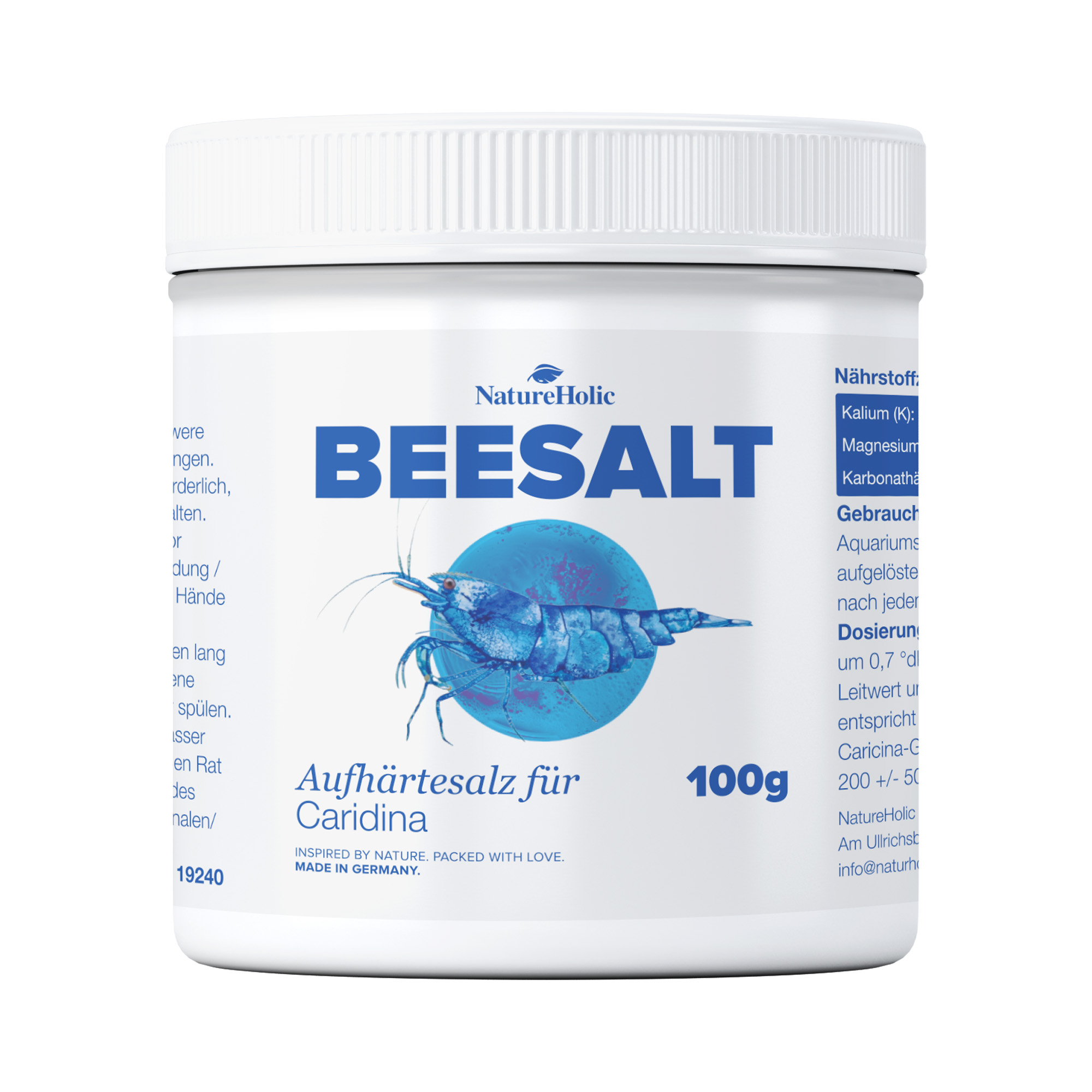
Our special chloride-reduced NatureHolic Beesalt Caridina hardening salt is a fast-dissolving hardening salt for all Caridina shrimp from soft water biotopes, for example bee shrimp, Caridina cantonensis, Caridina breeds such as Boa, Galaxy and Co. – and of course also for other dwarf shrimp that need soft water in the aquarium.
You can find a simple explanation and instructions for Beesalt in our blog: Hardening water for shrimp – it’s really easy!
Many invertebrates, and especially freshwater plants, are demonstrably sensitive to chloride ions. Many conventional aquarium remineralizing salts contain significant amounts of sodium chloride – which can be seen, for example, in the increased occurrence of algae such as the red alga Thorea ramosissima in soft water aquariums. This algae is actually only found in brackish water and can indicate the presence of chloride. To avoid this problem, we deliberately avoided chloride wherever possible in the formulation of NatureHolic Beesalt Caridina – NatureHolic Beesalt Caridina remineralizing salt contains up to 80% less chloride than comparable products.
When keeping Caridina shrimp from soft water habitats, it is also important to maintain the lowest possible carbonate hardness (KH). We took this important requirement into account when formulating our NatureHolic Beesalt Caridina hardening salt. The NatureHolic Beesalt hardening salt for shrimp was tested and approved in one of Germany’s largest invertebrate facilities, located here in Mannheim.
The chloride-reduced NatureHolic Beesalt Caridina remineralizing salt enriches the water with all important minerals and trace elements and is used to remineralize osmosis water, activated carbon filtered rainwater or distilled water.
Not only do dwarf shrimp benefit from the optimal composition of minerals and trace elements in NatureHolic Beesalt Caridina remineralizing salt for soft water aquariums, but also aquarium plants and the important filter bacteria, which depend on a good supply of trace elements and minerals to break down pollutants in the aquarium. The significantly reduced chloride content is also beneficial for aquarium plants and beneficial bacteria!
NatureHolic Beesalt Caridina, a chloride-reduced remineralizing salt, raises the general hardness (GH) and carbonate hardness (KH) by a ratio of GH/KH: 1/0.2, making it suitable for shrimp from soft water habitats. NatureHolic Beesalt Caridina also provides an ideal calcium-magnesium-potassium ratio of 2:1:0.5, which is beneficial for plant growth. It can therefore create naturally soft water conditions, promoting plant growth in the aquarium and the well-being of the aquarium inhabitants.
Instructions for use:
Stir the chloride-reduced remineralizing salt into the fresh water for water changes outside of the aquarium. Dispose of any undissolved particles in the aquarium. Reseal the container tightly after each use.
Important: Make sure you weigh the NatureHolic Beesalt using a precision scale for dosing. A kitchen scale, for example, would have too high a margin of error; over- or under-dosing the mineral salt can cause problems in the aquarium. Check the conductivity of your newly mixed bee water with a conductivity meter for aquariums and, if necessary, check the pH value in your shrimp aquarium with a pH meter .
Dosage:
10 g per 100 l increases the carbonate hardness by 0.7 °dKH, the total hardness by 3.4 °dGH, and the conductivity by approximately 120 µS/cm. Optimal target values for Caridina shrimp from soft water are: 1 °dKH, 5 °dGH, and 200 ± 50 µS/cm.
| Suitable for: | For Caridina species and other shrimp from soft water habitats, such as bee shrimp, tiger shrimp, Taiwan Bees, high-quality Caridina hybrids and others. |
| Ratio of GH to KH: | 1 to 0.2 |
| Calcium-magnesium-potassium ratio: | 2 : 1 : 0.5 |
| Dosage: | Always double-check with a suitable conductivity meter! The target value for soft-water Caridina shrimp is 200-250 microsiemens. 10 g per 100 l increases the carbonate hardness by 0.7 °dKH and the total hardness by 3.4 °dGH. One level teaspoon corresponds to approximately 5 g. |
| Optimal target values for soft water shrimp: | 1 °dKH, 5 °dGH and 200 + /- 50 µS/cm |


